
okinawa.js
A 2D engine written in plain JavaScript,
drawing on an HTML5 <canvas> with the 2D context, and with no runtime
dependencies at all: webpack and babel build the bundle, and nothing else
ships with it.
Where it was used
It stopped being a hobby project fairly early. Dozens of small serious games on pixie.es, a programming learning platform for children, ran on it: the teaching side used Google Blockly for the visual code blocks, and everything that moved on screen afterwards was okinawa.js. The platform was later bought by Sngular and renamed Sngular Kids.
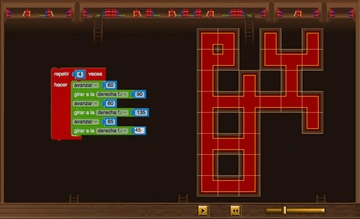
A pixie.es exercise: the child assembles the blocks on the left, and the level runs on the right.
It also ran several serious games built for the Faculty of Psychology at UNED, used as instruments in academic studies.
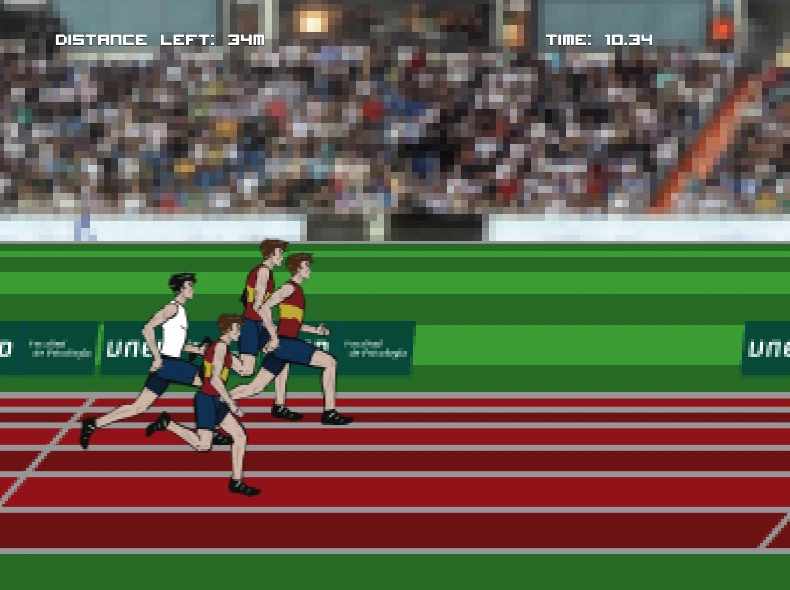
One of the UNED games, inspired by the button-mashing of the classic Track & Field.
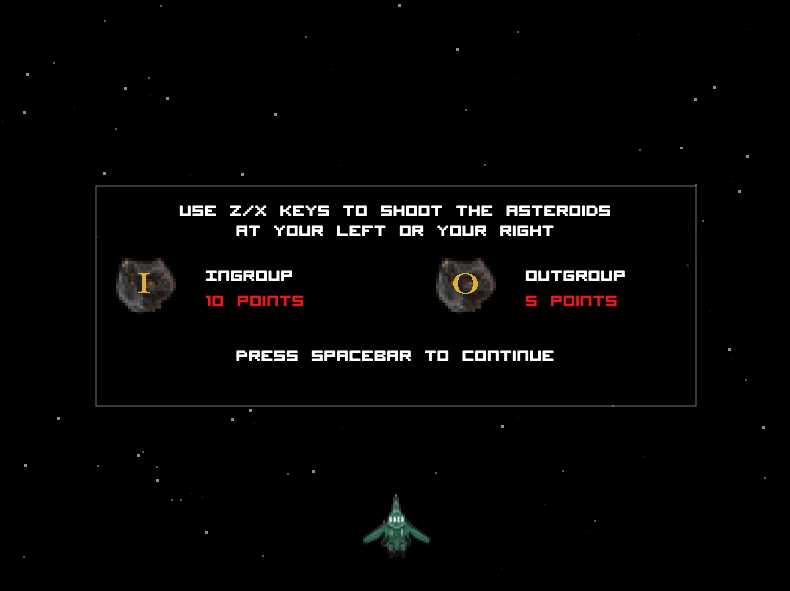
Another one: hitting the asteroid marked as the ingroup is worth twice the outgroup.
What is in it
A scene graph with a hierarchy of items that can be positioned and rotated relative to their parent, so a turret rotates with the tank it is bolted to. Scenes carry their own background collection with parallax, their own input controller and their own clock subscriptions.
Movement does not have to be written by hand frame by frame: trackers drive an item along a bezier curve, a circle, a sine wave, or make it follow another item. On top of that there is a particle system, a small GUI layer (text, console, menus, windows), sprite and sound preloading, and CSS fonts rendered once to images and only re-rendered when the text changes.
Input covers key subscriptions and real-time key state, combos of consecutive or simultaneous keys, and basic touch controls.
What it deliberately does not have: no physics engine, no tilemaps, no entity component system, no editor. Collisions are a radius per item and nothing more.
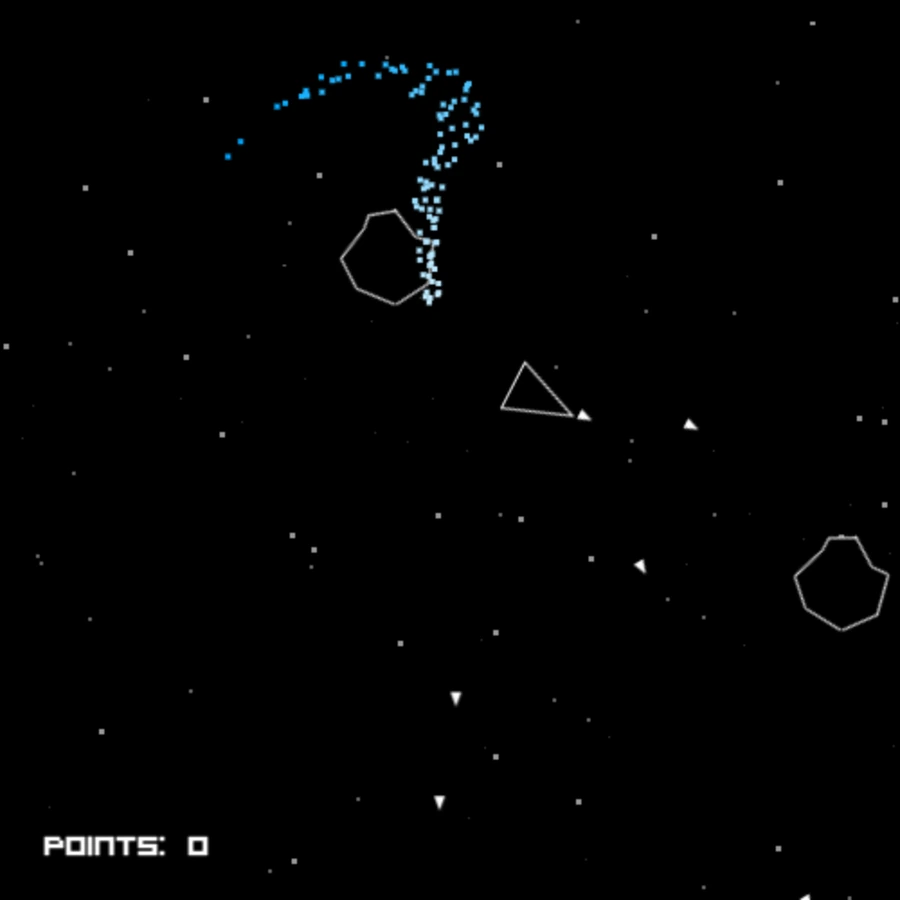
The demo that ships with the engine.
An Asteroids clone that exists to exercise the engine: the trail is the particle system, the HUD is the bitmap font layer, and the explosions are sprite strips.
Afterwards
The engine is published on npm as okinawa.js. It gets no time from me these
days, but the ideas carried on: okinawa takes them into 3D and
into C++, and is the one being worked on now.