Doom tools
Doom shipped its maps, textures, sounds and sprites inside a single archive called a WAD, and more than thirty years later people are still making them. The format is simple enough to read and awkward enough to be interesting: a map is not a mesh but a set of flat lines, the sectors between them, and the heights each sector claims for its floor and ceiling.
These are three tools for poking at that.
wadviewer
Loads a WAD and draws its level in 3D, with the original textures and a camera you can fly through it.
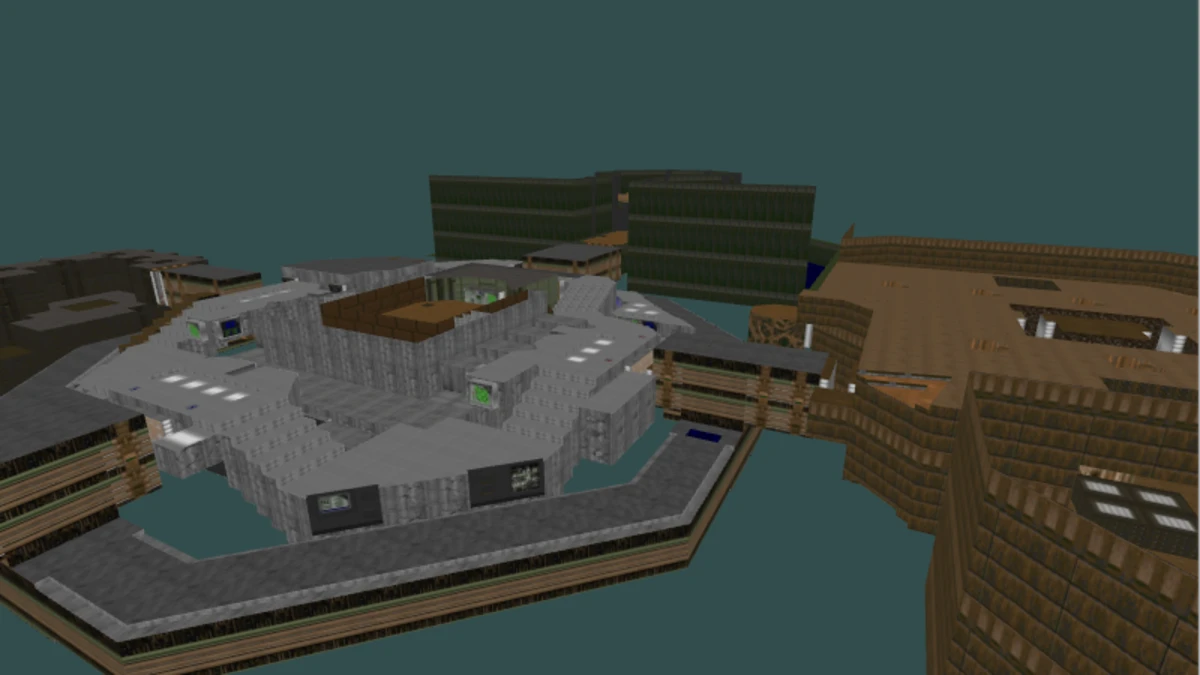
The geometry rebuilt from the file’s lines and sectors, with its textures on.
Almost no level people share is self-contained. The file holds the geometry and little else, and the texture names inside it point at the base game’s own archive, so opening one on its own renders it entirely white: every name resolves to nothing. The viewer loads both, the base first and the level on top, and settles the names the way Doom itself did. Whatever the later file defines wins, and anything it leaves out falls through to the base.
It is also the first real application of okinawa, which is a good way to find out which parts of an engine you actually got right.
Micro-tools
The other two are small on purpose. They exist because looking at one level is a different problem from looking at a thousand of them, which is what a collection of these files turns into.
wadconvert walks the archive’s directory and pulls out what makes a level a level: the vertices, the lines between them, the sides of those lines, the sectors they enclose and the things placed inside. It writes that four ways, a compact JSON and a verbose one with the names spelled out, and the same pair in a small text format of its own (a domain-specific language, or DSL). Compact when a thousand levels have to fit somewhere, verbose when a person has to read one. Once a level is JSON it can be measured, compared and queried with ordinary tools rather than with a reader for a format from 1993.
waddup answers the question that comes up as soon as the collection is large: which of these are the same file twice. They accumulate, the same level arrives under two names, and counting anything is wrong until the duplicates are gone.